There are combinations that, on paper, seem to have absolutely nothing to do with one another, until you see them together in the real world. A perfume house and a racing team could easily be one of them. One world seems to revolve around refinement, composition, French perfumers and the meticulous attention to detail required to create a fragrance that slowly unfolds on the skin, while the other is dominated by speed, technology, competition and the raw force of a machine accelerating from a standstill to hundreds of kilometres per hour.
If you look at both worlds only through their products, the connection is difficult to find.
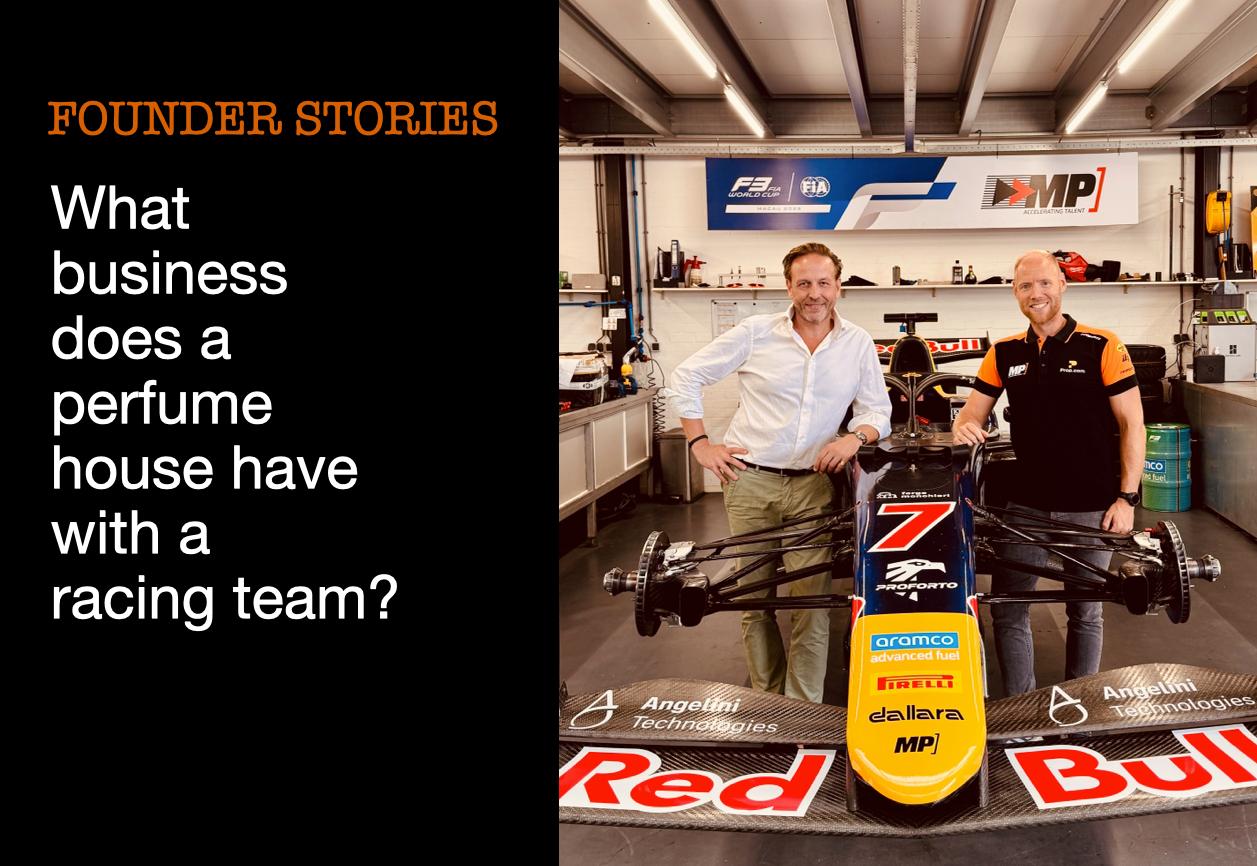
But yesterday, during the Open Day at MP Motorsport, while I was walking among the cars, drivers, engineers, mechanics and visitors, I found myself thinking again about why that connection is precisely what makes it so interesting to me. Because ultimately, a racing team is about far more than the car.
The car may be the most visible part of the world MP Motorsport has built, but what you actually experience as a visitor is a much larger whole, in which technology, speed, people, sound, architecture, tension and anticipation constantly overlap. You see the cars, you hear the engines, you watch mechanics working on a machine with an almost effortless precision, you see teams preparing themselves, and somewhere in between all of that are the scents you barely consciously register, yet which can ultimately become inseparably connected to the memory of such a day. That is precisely what fascinates me about fragrance.
We constantly talk about brands as though they primarily exist through what we can see. We design logos, colours, packaging, interiors and campaigns, and then spend enormous amounts of time deciding what a brand should look like and which words should accompany it. We are also increasingly conscious of what a brand should sound like and how a space should feel. Yet fragrance is still so often left outside that design process, even though it may be one of the most direct ways in which an environment can become embedded in our memory.
“You walk into somewhere, smell something, and suddenly you are somewhere else.”
Because you unconsciously remembered something. Because fragrance seems to have found its own route into our memory. A particular combination of wood, leather, citrus, flowers, metal, warmth or something entirely abstract can connect a place or a moment to an experience for years, without us ever consciously making that decision.
It is worth remembering that the connection between automotive culture and perfume is not quite as new as it might initially appear.
There is a wonderful anecdotal tradition surrounding the gentleman racers of the classic era, in which the idea that a driver should step out of his car after hours of racing not only as a winner, but also as a gentleman, was almost taken for granted. The idea that gloves and clothing might be perfumed so that, after a long day of leather, oil, heat and exhaust fumes, one would still smell pleasant, may seem rather unusual to us today, but perfuming gloves was for centuries an established practice among the European elite.
In fact, the story of the perfumed glove is closely connected to the history of French perfumery itself. In Grasse, where leatherworking was an important craft for centuries, leather gloves were perfumed to mask the unpleasant odour of the tanning process. Floral materials such as jasmine, rose and orange blossom were used for this purpose, and the gantiers-parfumeurs eventually developed into a craft of their own. The official recognition of the guild of glove makers and perfumers in the seventeenth century became one of the historical links in the development of Grasse as a centre of perfumery.
“I think there is something absolutely poetic about that history.”
Thierry Stravers
Founder & Creative Director